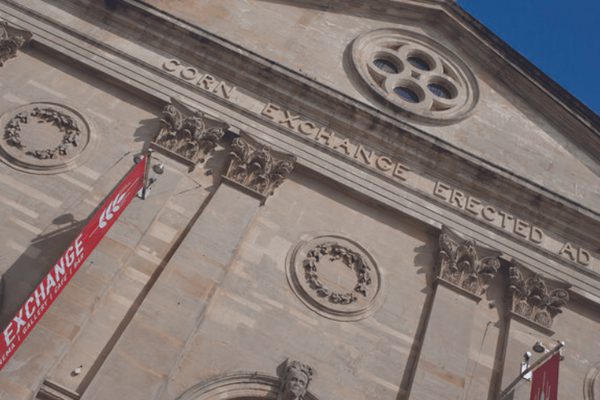
An interview with Charlotte Mooney, Director and writer of Comb coming to the Corn Exchange Newbury's Old Library

Ahead of the upcoming performance of Comb in the Old Library this autumn, we caught up with the show's writer and director to find out more about the story behind the production.
Below, she reflects on her creative journey so far, shares what audiences can expect from the Introduction to Storytelling Workshop she's leading before the performance, and reveals how the idea for Comb first took shape. Whether you're curious about the creative process or looking to get even more from your visit, this interview offers a fascinating insight into the people and stories behind the show.
An introduction to Charlotte...
My name is Charlotte Mooney. I started my performance career as a circus artist, specialising in aerial - so anything in the air - ropes and doubles trapeze being my speciality. I still run a circus company called Ockham’s Razor with my partner. We have spent many happy years making theatre from the movement of circus.
Many of our shows were originally without words - we told stories through the movement but I had always been drawn to stories and storytelling. 11 years ago when I was pregnant (and I didn’t much fancy climbing ropes) I decided to take the time to discover more about it. I went to The International School of Storytelling in Sussex and stayed there for months learning the art and craft of traditional storytelling. How to pass on stories person to person. How to take folklore and myth and make it come alive. It totally changed my life and how I thought about stories.
Since then I’ve been telling stories in theatres, round campfires, to children and adults across the UK.
What first drew you to theatre and performance, and can you remember a moment when you realised it might be what you wanted to pursue as your career?
I was always a dreamy kid. I spent a lot of time writing poems and a lot of time dancing - I was really into ballet. But I never thought that I could do either of those things for a living. I studied literature at university and I thought that maybe I would be a journalist. But in my spare time I was directing and acting in plays, day dreaming about writing novels and trying trapeze.
I found a flyer for a school in Bristol called Circomedia which trained people in circus and physical theatre and at the same time my friend Dave gave me a book called Exposure which was a collection of one person shows with the scripts of people like Laurie Andersen in it. It lit a fuse in me. It was people making their own shows blending live art, movement, stories. I thought 'THAT is what I need to do' and after I graduated from my degree I applied to Circomedia and told my family I was off to circus school. Everyone thought I was nuts!


Is there a story, or a storyteller that inspires you?
There are so many! In terms of storytellers my deepest inspiration was from my teacher Roi Gal-Or, he’s an amazing man. He was a doctor with Médicins Sans Frontières working with the most traumatised people in crisis zones. He would often hear and tell stories to people when treating them and he felt this that had the deepest impact on his patients and what made him want to become a story teacher. He really believes in people and in the power of storytelling and his life’s mission is to pass this on. He’s also a very funny teller. I’m also a massive fan of both Michael Harvey and Nell Phoenix.
At the moment I’m really inspired by the stories of Merlin and how they hold within them a glimpse of Britain’s early imagination - I love how stories are a kind of time travelling.
Comb blends autobiography with folklore. How did you decide where to draw the line between family history and theatrical imagination?
Comb is actually a very honest show. It’s about a quest I went on to find the origin of a story my Grandad told me when I was a child. It follows all the twists and turns I went on in that journey and I tell the stories I found along the way. There were for me some spine-tingling coincidences which honestly I have not embellished.
You're leading a storytelling workshop before the performance. What are the most important ingredients of a compelling story?
The main thing that the Storytelling School taught me was a process whereby you can unfold the story around you and step into it when you’re telling it. If you manage to do this then story kind of happens to you. You notice new things each time. I think the most compelling stories are when you see the storyteller getting genuinely surprised by something that they see and say.
You can find out more about Charlotte's workshop here:
What can audiences expect from Comb?
They can expect 80 mins of sometimes strange, sometimes chilling often beautiful stories. It’s a ride through Celtic and Slavic folklore and myth - as I try and discover how different stories are connected, how they travelling around the world and what they have to tell us today.
The word most used by audiences is that they were 'mesmerised'. I think the thing about listening to stories is that it’s active - audiences have said that they really loved being that deep in their imaginations - that it was something they remembered from childhood and hadn’t realised they missed.
After audiences leave Comb, what conversation do you hope they're still having on the journey home?
My favourite thing about performing Comb is that often audiences will come up to me afterwards and tell me stories from their families. I think that it brings up long forgotten family tales and bits of folklore. I hope that audiences on the way home will be telling each other stories.
Find out more about Charlotte's show, Comb, below:
Related articles
-
Things to do in Newbury this summer - Corn Exchange, Old Library and The Base
 More info on Things to do in Newbury this summer - Corn Exchange, Old Library and The Base
-
Introducing our new loyalty cards at the Corn Exchange Newbury and Old Library Café Bars
 More info on Introducing our new loyalty cards at the Corn Exchange Newbury and Old Library Café Bars
-
Corn Exchange Newbury marks the inaugural season of the Old Library with an extraordinary autumn programme
 More info on Corn Exchange Newbury marks the inaugural season of the Old Library with an extraordinary autumn programme